Transforming Lecture Halls: Active Learning Strategies for Large Classes
How to implement active learning in classes of 100+ students. Research-backed strategies that boost engagement without chaos.
Dr. Rebecca Foster
Professor of Psychology
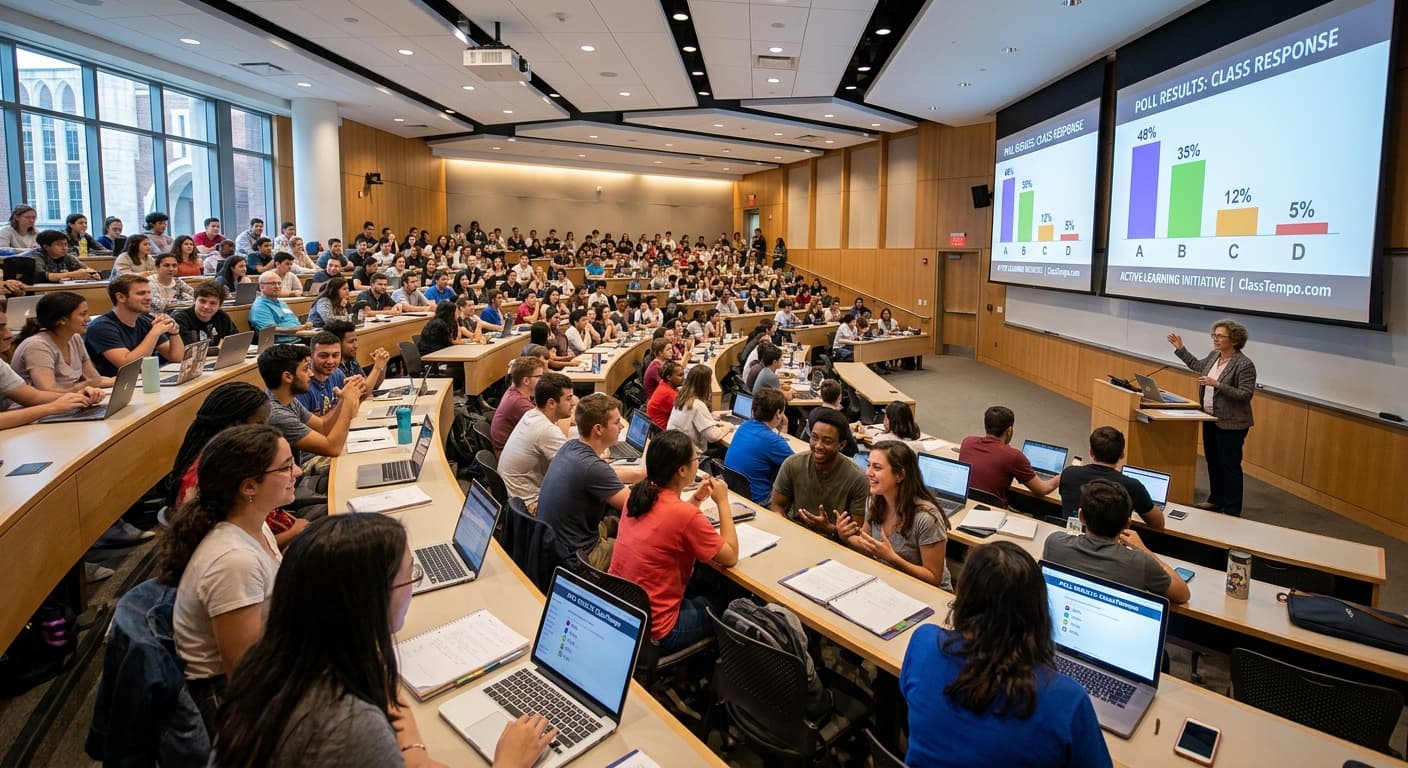
When I started teaching Introduction to Psychology, my 400-student lecture felt like a performance. I talked, they listened (or didn't), and we all went home. Engagement was abysmal.
Three years later, that same course has a 94% engagement rate, improved exam scores, and students who actually look forward to class. Here's how we made the transformation.
The Problem with Traditional Lectures
Research is clear: passive listening leads to poor retention. Students in traditional lectures:
But active learning in large classes seems impossible. How do you facilitate discussion with 400 people? How do you ensure participation without chaos?
Our Approach: Structured Active Learning
The key insight was that "active" doesn't mean "chaotic." We implemented structured protocols that scale to any class size.
Peer Instruction Protocol
Developed by Harvard physicist Eric Mazur, peer instruction works like this:
1. Present a concept (5-7 minutes) 2. Pose a conceptual question 3. Students vote individually 4. If results are mixed, students discuss with neighbors (2-3 minutes) 5. Students vote again 6. Reveal correct answer and explain
This works because:
Think-Pair-Share at Scale
We use a modified think-pair-share:
1. Think: Pose question, 60 seconds silent thinking 2. Pair: 90 seconds discussing with neighbor 3. Share: Poll the class for responses
The polling component is crucial. Without it, the "share" phase becomes dominated by a few vocal students.
Muddiest Point
At designated points in lecture, we ask: "What's the muddiest point so far?"
Students submit short-answer responses via ClassTempo. We can see common confusions in real-time and address them before moving on.
Technology That Made It Possible
We needed technology that could:
Traditional clickers were expensive and cumbersome. ClassTempo let students use their own phones, which they already had in hand anyway.
Results After Three Years
Engagement Metrics
- Participation rate: 94% (up from ~15% raising hands)
- Average responses per student per class: 12
- Students reporting "high engagement": 78%
Learning Outcomes
- Exam scores: +8% average improvement
- DFW rate: Decreased from 22% to 14%
- Concept retention (2-week delay): +23%
Student Feedback
- "First time I've enjoyed a large lecture"
- "I actually know if I understand before the exam"
- "Discussing with classmates helps me learn"
Lessons Learned
Start Slow
Don't try to transform your lecture overnight. We started with 3-4 polling questions per class, then gradually added more interactive elements.
Explain the Why
Students initially resisted the change. Once we explained the research on active learning, buy-in improved dramatically.
Embrace Discomfort
Early sessions felt awkward. The room was noisy during discussions. It looked different from traditional teaching. That's okay—it's working.
Technology Should Be Invisible
The tool you choose should work seamlessly. If there's friction, participation drops. We moved to ClassTempo because students could join with a code—no accounts, no apps.
Anonymous Responses Matter
Students are more honest when responses are anonymous. We get better data on actual understanding, and shy students participate equally.
Addressing Common Concerns
"Won't this take time away from content?"
Yes, and that's the point. Covering less content but ensuring deeper understanding beats racing through slides that students don't absorb.
"What about students who don't have smartphones?"
This was less of an issue than expected (~2% of students). We have loaner devices available and allow laptop access.
"How do I grade participation?"
We track participation through the polling system. Students get credit for participating, not for being correct. This encourages honest responses.
"What if students just click randomly?"
Response patterns make random clicking obvious. More importantly, the peer discussion component requires actual engagement.
A Typical Class Session Now
Here's what a 75-minute session looks like:
- 0:00-0:05: Warm-up poll on previous material
- 0:05-0:15: Mini-lecture on first concept
- 0:15-0:22: Peer instruction sequence
- 0:22-0:32: Mini-lecture on second concept
- 0:32-0:38: Think-pair-share activity
- 0:38-0:48: Mini-lecture on third concept
- 0:48-0:55: Peer instruction sequence
- 0:55-0:65: Application activity
- 0:65-0:70: Muddiest point
- 0:70-0:75: Wrap-up and preview
Never more than 15 minutes of straight lecturing. Activity every 10-12 minutes.
Getting Started in Your Large Class
1. This week: Add 3 polling questions to your next lecture 2. Next month: Implement one peer instruction sequence per class 3. This semester: Build a full active learning routine 4. Next semester: Refine based on data and feedback
You don't need to be perfect. You just need to start.
Conclusion
Large lectures don't have to be passive. With structured protocols and the right technology, you can achieve engagement rates that rival small seminars.
The research is clear. The tools are available. The only remaining question is: when will you start?