How to Write Poll Questions That Actually Reveal Student Understanding
Not all poll questions are created equal. Learn the research-backed techniques for crafting questions that expose misconceptions and drive deeper learning.
Dr. Sarah Chen
Education Specialist at ClassTempo
You've added a poll to your lesson. Students tap their answers. Results appear. Now what?
The power of real-time polling isn't in the technology—it's in the questions you ask. A well-designed poll question can reveal hidden misconceptions, spark productive debate, and show you exactly what students understand before you move on.
Here's how to write questions that do more than just check attendance.
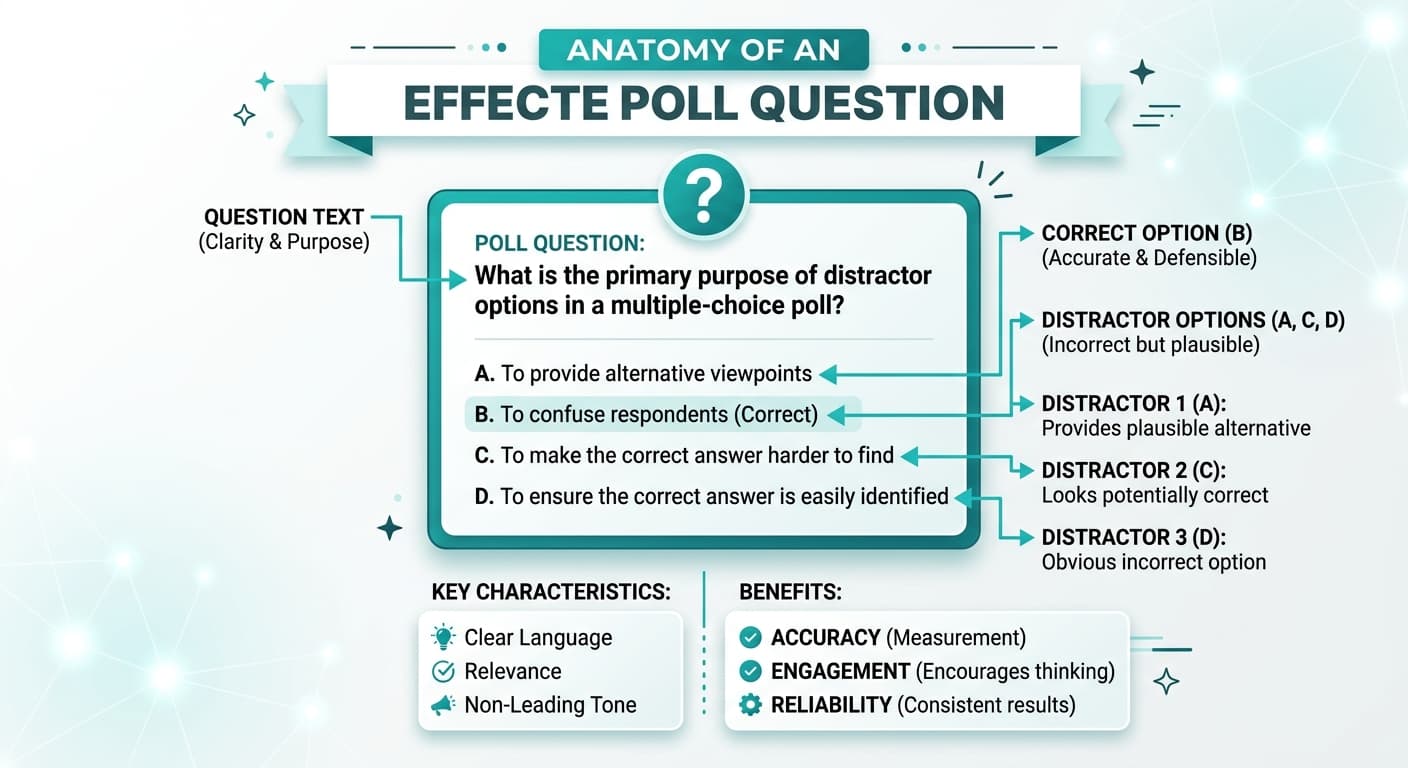
The Anatomy of a Powerful Poll Question
Start with the Learning Goal
Before writing your question, ask yourself: "What specific understanding am I trying to assess?" The clearer your target, the more useful your question.Weak: "Do you understand photosynthesis?" Strong: "Where does the mass of a growing tree come from?"
Design Wrong Answers Carefully
In multiple choice polls, your distractors (wrong answers) should reflect real student misconceptions—not obviously wrong options.Research on photosynthesis shows that many students believe plants get their mass from soil. If that's not an option, you won't discover this misconception.
Less useful:
More useful:
Notice how every wrong answer represents a genuine student belief.
Question Types That Drive Learning
The Prediction Question
Ask students to predict an outcome before demonstrating or explaining."If I drop a heavy ball and a light ball at the same time, which will hit the ground first?"
This activates prior knowledge and creates curiosity about the answer.
The Application Question
Move beyond recall to see if students can use concepts."A plant is placed in a sealed jar with plenty of water and sunlight. After one week, the plant is wilting. Why?"
The Edge Case Question
Test the boundaries of understanding with unusual scenarios."An ice cube is floating in a glass of water. When the ice melts completely, will the water level rise, fall, or stay the same?"
The Comparison Question
Have students identify similarities or differences."Which of these processes requires energy input: diffusion, osmosis, or active transport?"
The Golden Rule: Make Thinking Visible
The best poll questions don't just tell you who's right—they reveal how students are thinking. When you can see the reasoning behind wrong answers, you can address the underlying confusion.
Using Results Effectively
When everyone gets it right
Move on confidently, but consider: Was the question too easy?When answers are split
This is the goldmine. Have students discuss with someone who chose differently. Then re-poll. Research shows this "peer instruction" technique dramatically improves understanding.When most get it wrong
Don't just give the answer. Ask: "What would need to be true for each of these options to be correct?" Then revisit the concept.Quick Tips
1. Keep questions focused — Test one concept at a time 2. Avoid "all of the above" — It reduces diagnostic value 3. Time it right — Check understanding before moving on, not just at the end 4. Make it low-stakes — Students should feel safe being wrong 5. Follow up — The poll is the beginning of the conversation, not the end
Start Practicing
Great poll questions take practice to write. Start with one lesson this week. After each poll, reflect: Did the results surprise you? What did you learn about student thinking?
Over time, you'll build a library of high-quality questions that transform your teaching.
ClassTempo makes it easy to create and deploy polls in seconds. Start your free trial and see the difference real-time feedback makes.