Getting Quiet Students to Participate: Strategies That Actually Work
Research-backed approaches for engaging introverted and reluctant students in classroom discussions without putting them on the spot.
Dr. Sarah Mitchell
Education Researcher
Every classroom has them: students who clearly understand the material but never raise their hands. They're not disengaged—they're just quiet. And traditional participation strategies often make things worse.
Here's how to create an inclusive discussion environment that works for all personality types.
Understanding Quiet Students
Why Some Students Don't Speak Up
It's rarely laziness. Common reasons include:
Processing Style: Introverts often need time to formulate thoughts before speaking. By the time they're ready, the conversation has moved on.
Fear of Judgment: Some students worry about looking foolish in front of peers—a fear that public participation amplifies.
Cultural Background: In some cultures, speaking up in class is seen as showing off or disrespecting the teacher's authority.
Language Barriers: Non-native speakers may understand perfectly but hesitate to speak publicly.
Past Experiences: Students who've been mocked or shut down before learn to stay silent.
What Doesn't Work
Cold calling: Puts students on the spot, increases anxiety, and often backfires.
Participation grades: Rewards extroversion rather than learning.
"Class discussions": Usually means 5-6 students talking while others observe.
Waiting longer: Awkward silence doesn't help students who need private processing time.
Strategies That Actually Work
1. Write Before You Speak
Give students time to formulate thoughts in writing before any verbal discussion:
- Pose a question
- Give 2-3 minutes of silent writing time
- Then open discussion
Students who've written something are far more likely to share it.
2. Digital Response Channels
Anonymous polling and text-based responses equalize participation:
- Every student responds, not just volunteers
- Quieter students see their answers valued equally
- You can surface interesting responses: "Several people mentioned X..."
This isn't avoiding participation—it's redefining it.
3. Think-Pair-Share
The classic works because it provides graduated exposure:
- Think: Private processing time
- Pair: Low-risk practice with one peer
- Share: More confident participation with broader group
The key is actually giving time for each phase. Don't rush.
4. Small Group Structures
Some students who won't speak to 30 people will freely discuss with 3:
- Break into small groups for discussion
- Assign roles (reporter, note-taker, etc.)
- Have groups share summaries rather than individuals
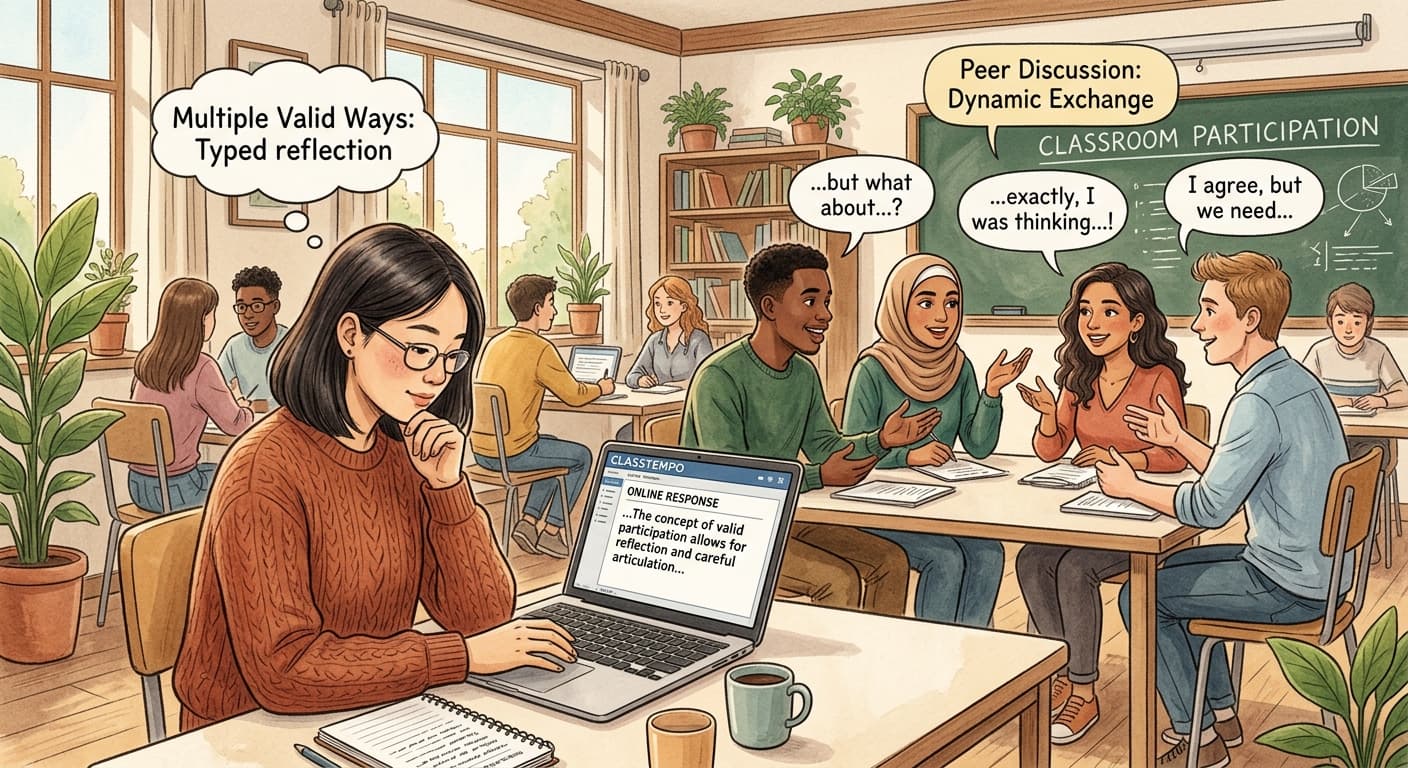
5. Multiple Participation Modes
Expand your definition of participation:
- Written reflections
- Digital polling responses
- Small group contributions
- One-on-one conversations
- Asynchronous discussion boards
Grade on total engagement, not public speaking.
6. Transparency About Process
Tell students why you use certain strategies:
"I'm giving writing time because research shows it leads to richer discussion."
"We're using anonymous polling so everyone's voice is heard equally."
This frames the approach as pedagogically intentional, not accommodating weakness.
7. Build Relationships First
Students participate more when they feel known:
- Learn names quickly
- Notice and acknowledge contributions
- Connect individually outside whole-class settings
- Show genuine interest in their thinking
Relationship precedes vulnerability.
8. Normalize Multiple Response Styles
Explicitly value different participation modes:
"I noticed interesting points in both the verbal discussion and the poll responses."
"Some of the most insightful comments came through the chat today."
When quiet participation is visibly valued, quiet students engage more.
Creating a Safer Discussion Environment
Establish Norms Early
Co-create classroom discussion norms:
- No interrupting
- Build on others' ideas
- Disagreement with respect
- Questions welcomed
- No judgment for wrong answers
Reduce Stakes
Low-stakes discussion is easier:
- Use "practice" discussions before graded ones
- Allow revision of responses
- Focus on thinking process, not correct answers
- Celebrate productive struggle
Address Problematic Dynamics
If some students dominate:
- Use structured protocols (timed responses, round-robins)
- Private conversations with dominant voices
- Physical arrangements that distribute attention
Model Vulnerability
Show that uncertainty is acceptable:
- Share your own questions
- Acknowledge when you don't know
- Celebrate changed minds
Working With, Not Against, Introversion
Recognize Introversion as Strength
Introverts often:
- Listen more carefully
- Think more deeply
- Catch nuances others miss
- Prefer quality over quantity
Frame quiet as strength, not deficit.
Provide Processing Time
Build in reflection:
- Advance questions before class
- Pauses during discussion
- Written warm-ups
- Time to formulate before responding
Allow Asynchronous Contribution
Not everything needs to be live:
- Discussion boards for continued conversation
- Written responses after class
- Revision opportunities
Create Smaller Venues
Introverts often shine in small settings:
- Office hours
- Small group projects
- Pair work
- Written exchanges
Rethinking Participation Assessment
Grade Engagement, Not Extroversion
Create rubrics that value:
- Quality of written contributions
- Preparation and reading
- Peer collaboration
- Active listening (follow-up questions)
- Digital participation
Use Multiple Data Points
Don't rely on in-class observation alone:
- Track digital responses
- Review written work
- Consider small group reports
- Include self-assessment
Communicate Expectations Clearly
Students should know:
- How participation is defined
- What behaviors earn credit
- Multiple pathways to full marks
Moving Forward
The goal isn't to turn introverts into extroverts. It's to create learning environments where all students can demonstrate their thinking.
Start by adding one strategy:
- This week: Add 2 minutes of writing time before your next discussion
- Next week: Use anonymous polling for a controversial question
- This month: Experiment with think-pair-share
Notice what changes. Your quietest students might have the most to say—they just need a different way to say it.